


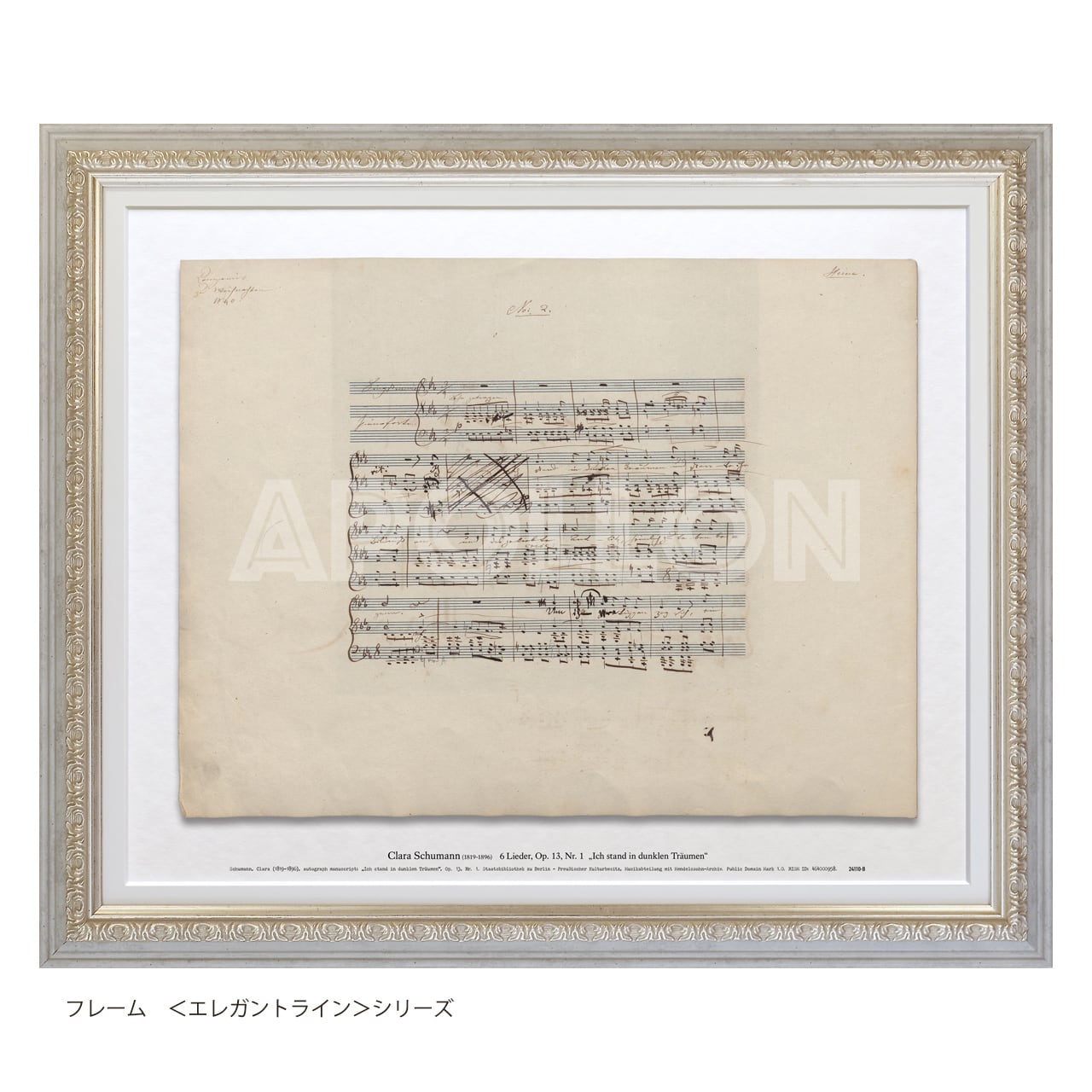
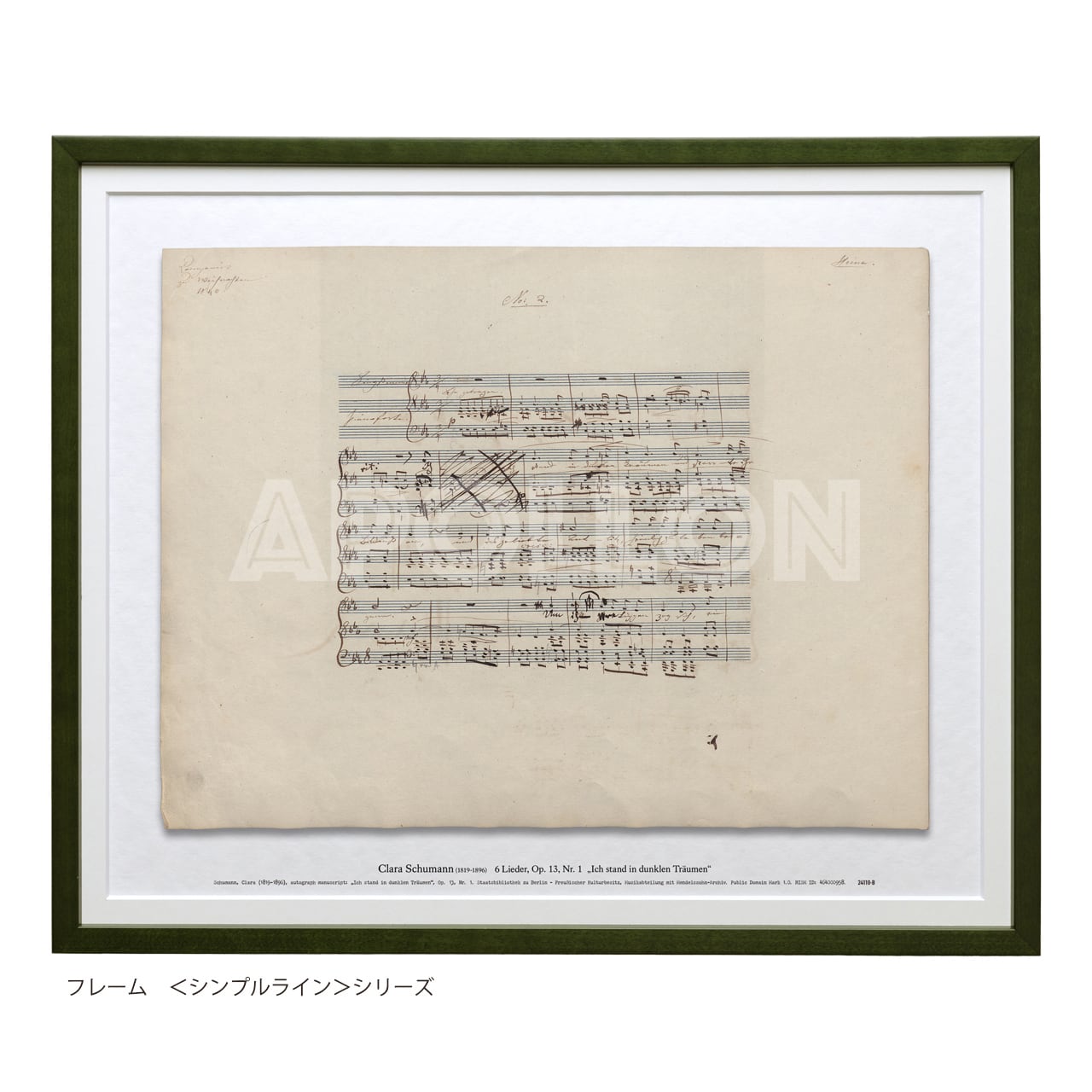


クララ・シューマン:6つの歌 より「僕は暗い夢の中にいた」Op. 13, Nr. 1/Clara Schumann:6 Lieder, Op. 13, Nr. 1 „Ich stand in dunklen Träumen“
¥14,630 ($92.68)
Schumann, Clara (1819–1896)
6 Lieder, Op. 13, Nr. 1
„Ich stand in dunklen Träumen“
《商品説明》 Product Specifications
◉プリントタイプ/高精細ジークレープリント
Print Type: High-definition Giclée print
◉出力紙/ドイツ製ハーネミューレ ファイン・アート紙(アシッドフリー)
Paper: Hahnemühle Fine Art Paper (Made in Germany, Acid-free)
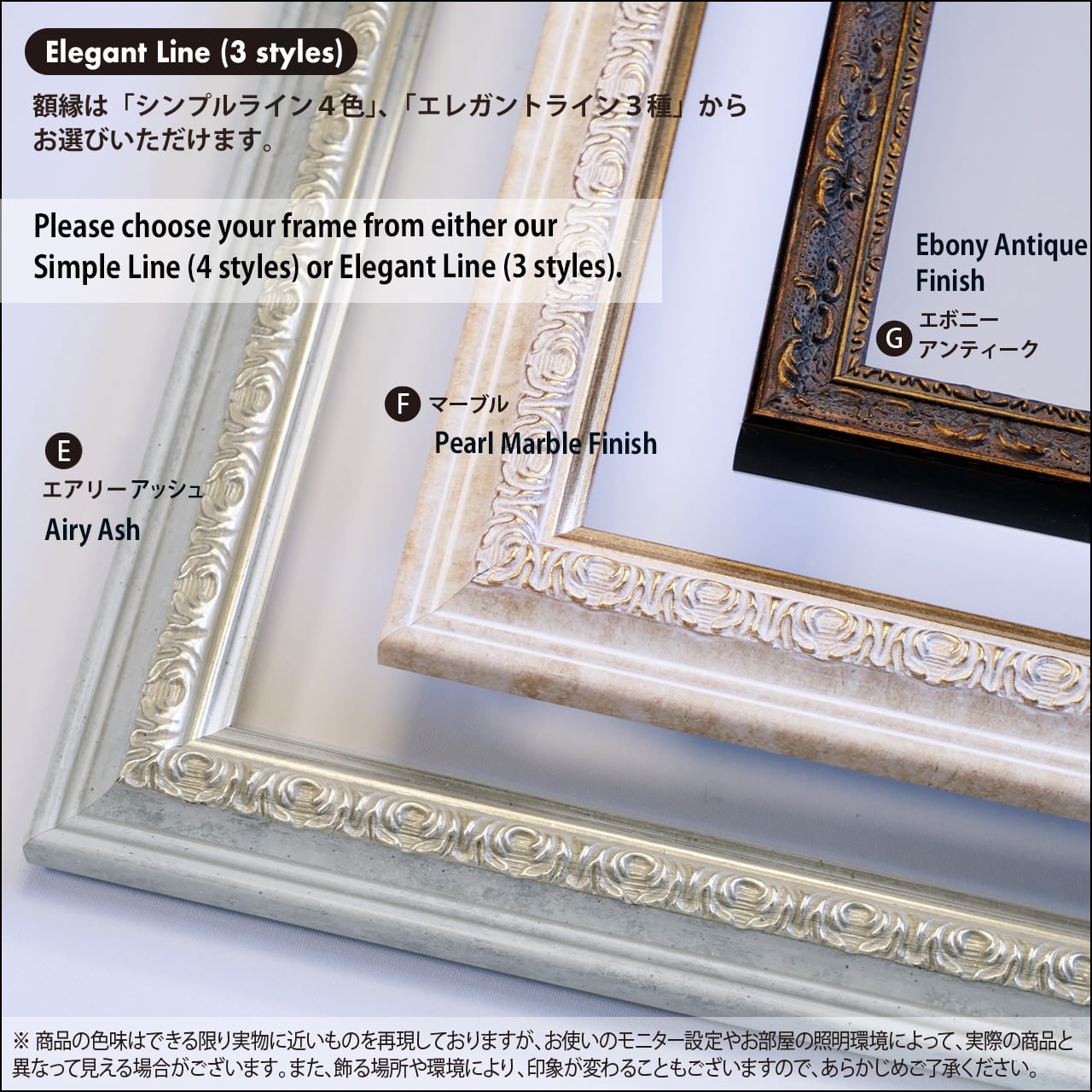
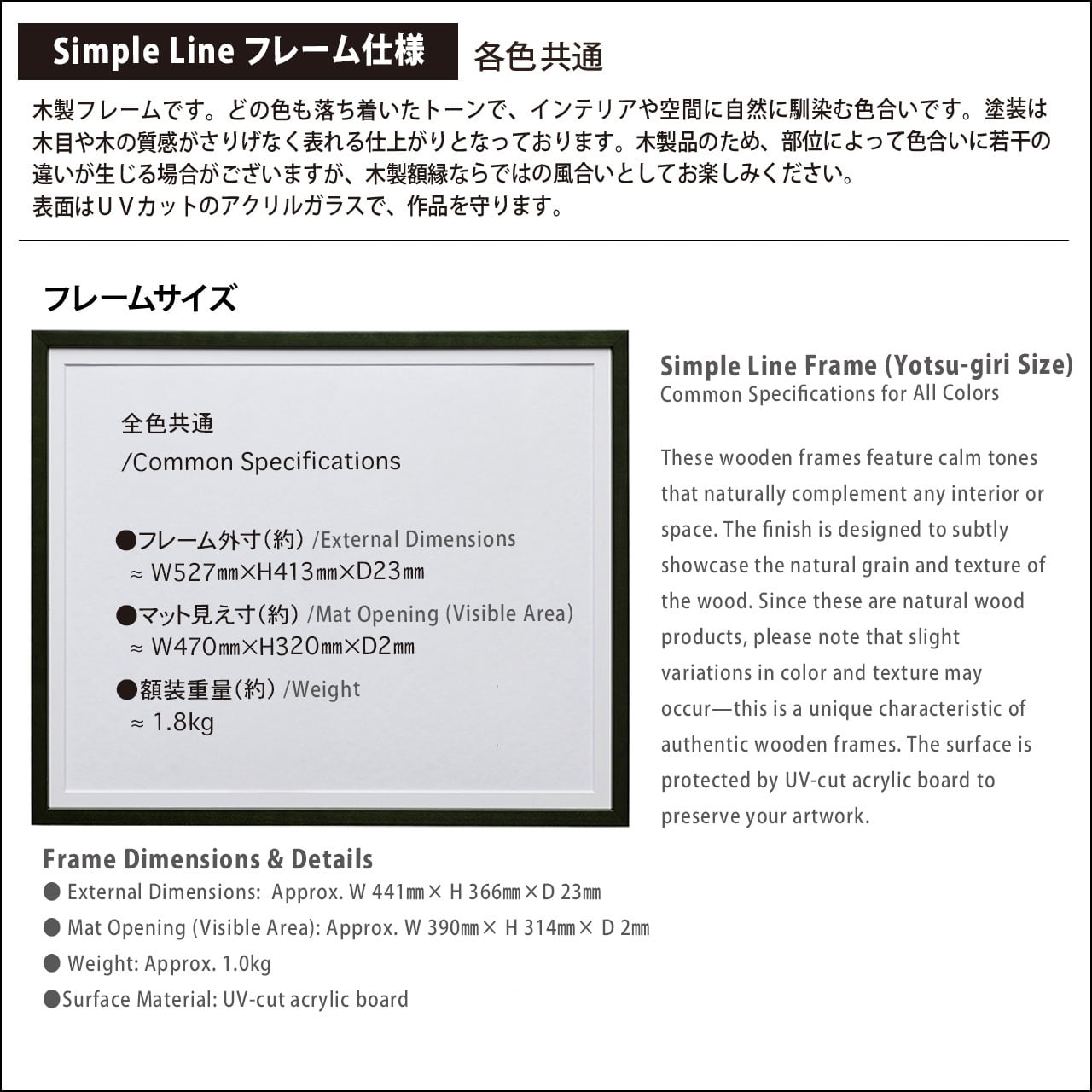
◉額縁/UVカットアクリルガラス、中性紙マット、吊元金具(額側)、吊紐、外箱
Framing: UV-protective acrylic glazing and acid-free mat
Accessories: Hanging hardware (pre-installed), hanging cord
〜自筆譜に残された愛の証:1840年、クララからのクリスマスの贈り物〜
クララ・シューマンの歌曲は、ピアニストとしての華々しい活躍の陰に隠れがちですが、内省的で繊細な感情表現を持つ作品を数多く残しています。
特に《6つの歌曲 作品13》第1曲 „Ich stand in dunklen Träumen“ は、ハインリヒ・ハイネ(Heinrich Heine)の詩に寄せられた、短いながらも深い詩情を持つ歌曲であり、クララ・シューマンの歌曲作品の代表的な一曲として知られています。
この歌曲の歌詞は、ハイネの詩集『歌の本』(Buch der Lieder)に収められた詩から採られています。ハイネの詩は、ロマンティックな美しさの奥に、憂愁や諦念、複雑な感情を秘めていることでも知られています。クララは、その繊細な心理描写を音楽へと映し出し、短い作品の中に深い感情の変化を凝縮しました。
<日本語訳(意訳)>
私は暗い夢の中に立ち、
彼女の肖像を見つめていた。
すると、その愛しい顔が
ひそかに生き始めた。
その唇には不思議な微笑みが浮かび、
その瞳からは
澄んだ悲しみの涙がこぼれ落ちた。
その頬もまた青ざめ、濡れてゆき、
大理石の像のような冷たい姿の奥で
彼女はひそかに泣いていた。
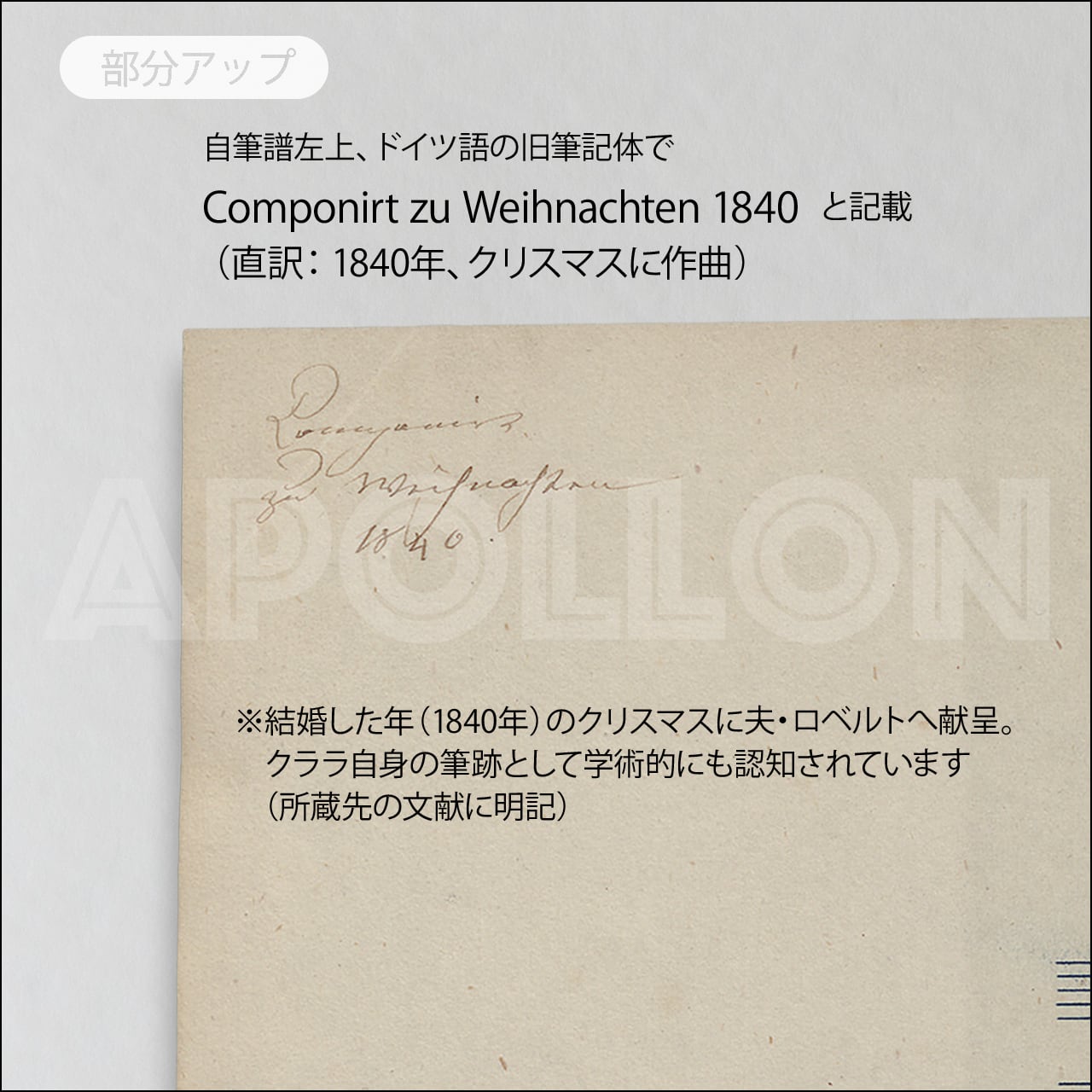
この歌曲は、クララが二十代前半であった1840年、ロベルトとの結婚の年のクリスマスに作曲されました。
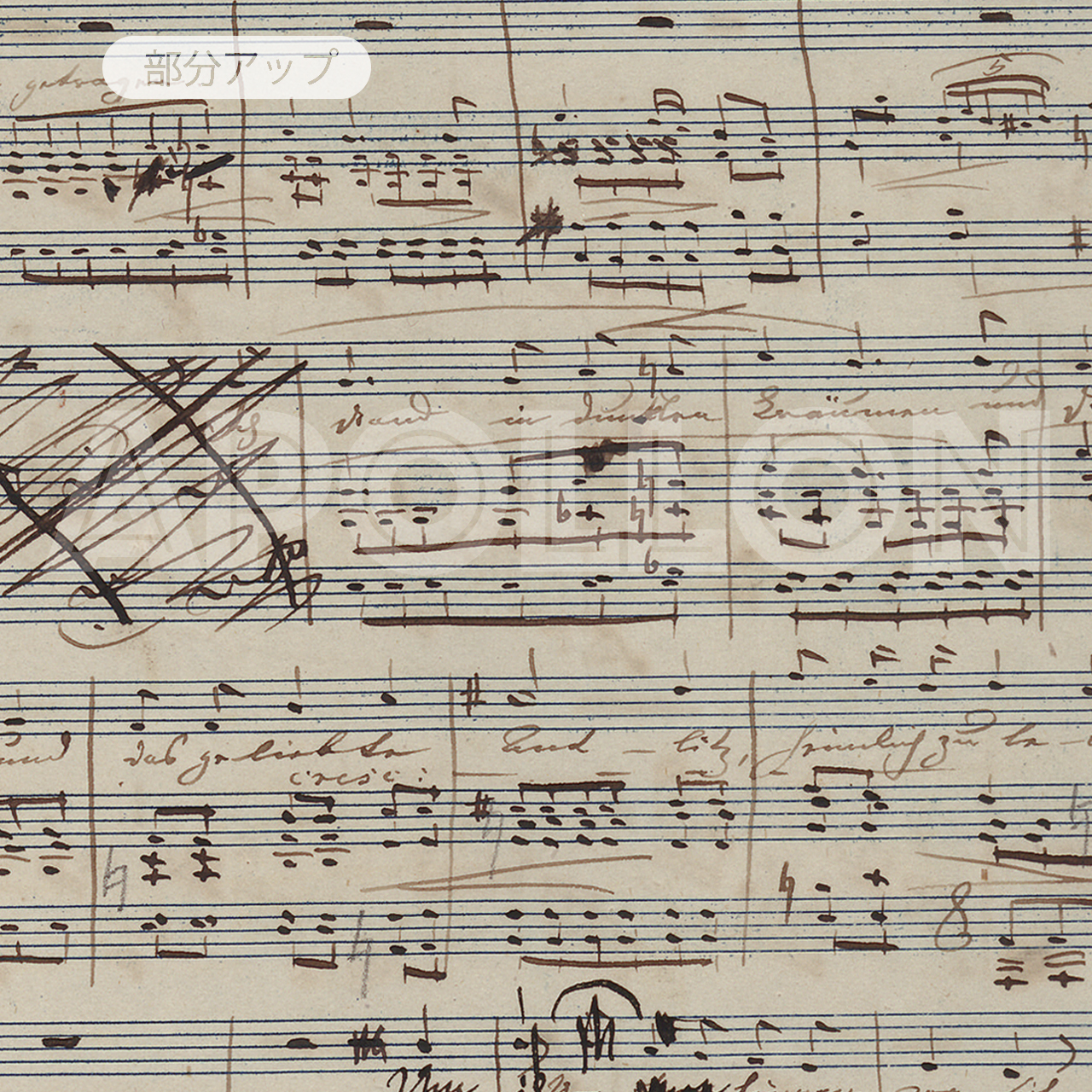
自筆譜左上には、クララ自身によって
「Componirt zu Weihnachten 1840.(1840年のクリスマスに作曲)」
と記されています。また右上には「Heine」と記されており、この作品がハイネの詩による歌曲であることを示しています。
この記載が残された1840年は、クララとロベルトが結婚した特別な年でもありました。この歌曲は、愛するロベルトへの贈り物として、あるいは新しい人生をともに歩み始めた二人の時間の中で生まれた音楽として、静かな思いが込められた作品なのかもしれません。
この時期、ロベルト・シューマンは1840年を「歌曲の年」と呼ばれるほど精力的な歌曲創作に取り組んでいました。クララもまた、ピアニストとして活動する一方で、作曲家として自らの音楽的表現を深めていました。
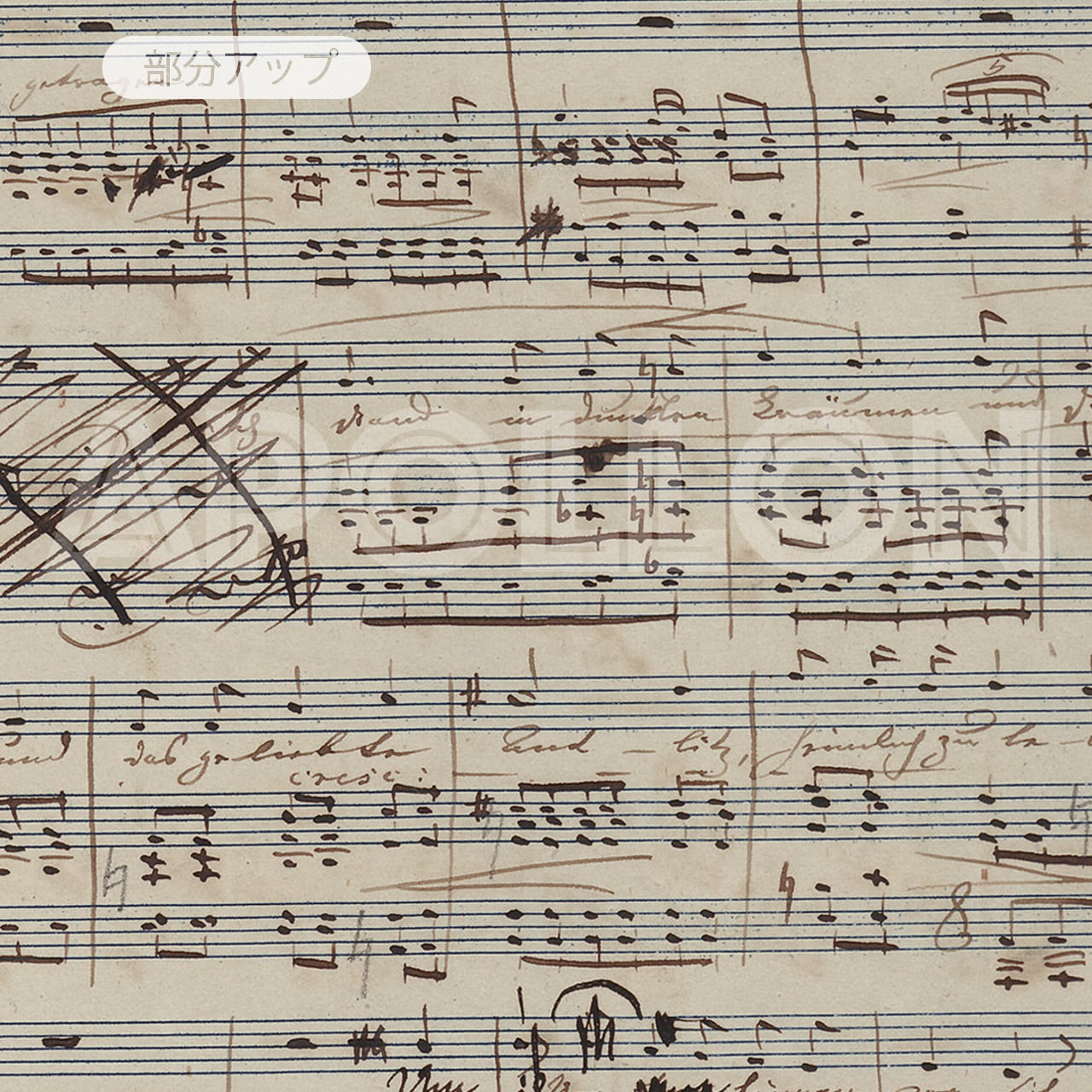
この曲の大きな魅力は、ピアノ・パートが単なる伴奏にとどまらず、詩の情景や心の動きを映し出す重要な役割を担っている点にあります。
「暗い夢」の始まりでは、揺れ動く和声や繊細な響きが、夢と現実の境界にあるような不安定な雰囲気を生み出します。そして、肖像が「生き始める」瞬間には、旋律が次第に高まり、感情の揺らぎが音楽の中に浮かび上がります。
しかし、その夢は永遠には続きません。詩に描かれる悲しみのイメージとともに、音楽は再び静かな憂いの世界へ戻っていきます。
„Ich stand in dunklen Träumen“ は、クララ・シューマンが卓越したピアニストであるだけでなく、詩の内面を深く読み取り、それを繊細な音楽表現へと変える作曲家であったことを伝える貴重な作品です。
なお、この自筆譜には、出版時には《6つの歌曲 作品13》第1曲となったにもかかわらず、タイトル部分にクララ自身の筆で「No: 2.」という表記が残されています。この記載は、歌曲集が編成されていく過程を伝える、自筆譜ならではの興味深い痕跡です。
〜A Testament of Love Preserved in Manuscript: Clara Schumann’s Christmas Gift of 1840〜
Clara Schumann’s songs have sometimes been overshadowed by her extraordinary career as a pianist. Yet, her compositions reveal a deeply introspective and delicate expression of emotion, leaving behind a remarkable body of lyrical works.
Among them, “Ich stand in dunklen Träumen,” the first song of 6 Lieder, Op. 13, is a work of profound poetic sensitivity based on a poem by Heinrich Heine. Although brief in length, it contains a rich emotional world and is regarded as one of Clara Schumann’s most significant songs.
The text is taken from Heinrich Heine’s poetry collection Buch der Lieder (Book of Songs). Heine’s poetry is known for its romantic beauty intertwined with melancholy, resignation, and complex emotional layers. Clara captured the subtle psychological atmosphere of the poem and condensed its changing emotions into a miniature yet deeply expressive musical form.
<English rendering of the poem>
I stood within dark dreams
and gazed upon her portrait.
Then her beloved face
began to quietly come alive.
A mysterious smile appeared
upon her lips,
and from her eyes
clear tears of sorrow fell.
Her cheeks grew pale and wet,
and behind the cold stillness
of marble-like beauty,
she was silently weeping.
This song was composed around Christmas of 1840, when Clara was in her early twenties and had just married Robert Schumann.
In the upper left corner of the autograph manuscript, Clara herself wrote:
“Componirt zu Weihnachten 1840.”
(“Composed at Christmas 1840.”)
In the upper right corner, the word “Heine” appears, indicating that the work is based on a poem by Heinrich Heine.
The year 1840 was a particularly significant time in Clara and Robert Schumann’s lives, as it was the year of their marriage. This song may be understood as a musical gift offered to her beloved Robert, or as a work born from the shared moments of a new life they had begun together, carrying within it a quiet and intimate sentiment.
During this same period, Robert Schumann entered his celebrated “Year of Song” in 1840, creating an extraordinary number of vocal works. Clara, while continuing her career as a pianist, was also deepening her own artistic voice as a composer.
One of the greatest qualities of this song lies in its piano writing, which goes far beyond a simple accompaniment and plays an essential role in portraying the atmosphere of the poem and the movement of the emotions.
At the opening image of the “dark dream,” subtle harmonic shifts and delicate textures create an atmosphere suspended between dream and reality. As the portrait begins to “come alive,” the melody gradually rises, allowing the inner movement of emotion to emerge through the music.
Yet the dream cannot continue forever. Together with the poem’s images of sorrow and loss, the music gently returns to a world of quiet melancholy.
“Ich stand in dunklen Träumen” reveals Clara Schumann not only as a brilliant pianist, but also as a composer with a profound understanding of poetry and the ability to transform delicate human emotions into music.
Interestingly, although this song was later published as the first piece of 6 Lieder, Op. 13, the autograph manuscript still bears Clara’s own handwritten marking “No: 2.” above the title. This small notation remains as a fascinating trace of the process through which the song collection was formed.
※Pay IDからご覧の方は下記URL(当店サイト)に
額の色目、仕様等、詳しく載っていますので、ぜひご確認下さい。
https://apollon.kooki-museum.com
<商品画像と実物の色味について>
商品の色味については、できる限り実物に近づけるよう調整を行っておりますが、お使いのモニター設定や機種、お部屋の照明環境によっても、実際の商品と異なって見える場合がございます。また、所蔵機関のスキャニングデータに基づくため、オリジナルの自筆譜と色味が異なることもございます。あらかじめご理解いただきますようお願い申し上げます。なお、一部の作品には、裏写り(裏面の楽譜の透け)、経年によるシミ、または原資料の修復に由来する痕跡が見られる場合がありますが、これは所蔵先のスキャニングデータに起因するもので、原稿の忠実な再現です。
<Important Notes on Color & Appearance>
Color Consistency:The actual color may vary depending on your monitor settings or room lighting. As these prints are based on official institutional scans, minor color variations from the original manuscript may occur.
<Image Detail & Historical Authenticity>
Some prints may show "bleed-through" (musical notation from the reverse side), authentic age spots, or visible restoration marks from the original source. These are not defects, but a faithful reproduction of the original historical manuscript, preserved to maintain its archival character.
▼【Reference】
YouTube Channel: バーバラ・ボニー - トピック
-
 クララ・シューマン:ピアノとヴァイオリンのための3つのロマンス 第1曲 Op.22-1/Schumann, Clara: Drei Romanzen, Op. 22, Nr. 1: Andante molto¥14,630 ($92.68)
 -
 クララ・シューマン :ピアノとヴァイオリンのための3つのロマンス 第2曲 Op.22-2/Schumann, Clara (1819–1896): Drei Romanzen, Op. 22, Nr. 2: Allegretto¥14,630 ($92.68)
 -
 クララ・シューマン:ピアノのための3つのロマンス 第1曲 Op. 21-1/Clara Schumann:Drei Romanzen für Klavier Op. 21 Nr. 1 (Widmung an Robert Schumann)¥14,630 ($92.68)